

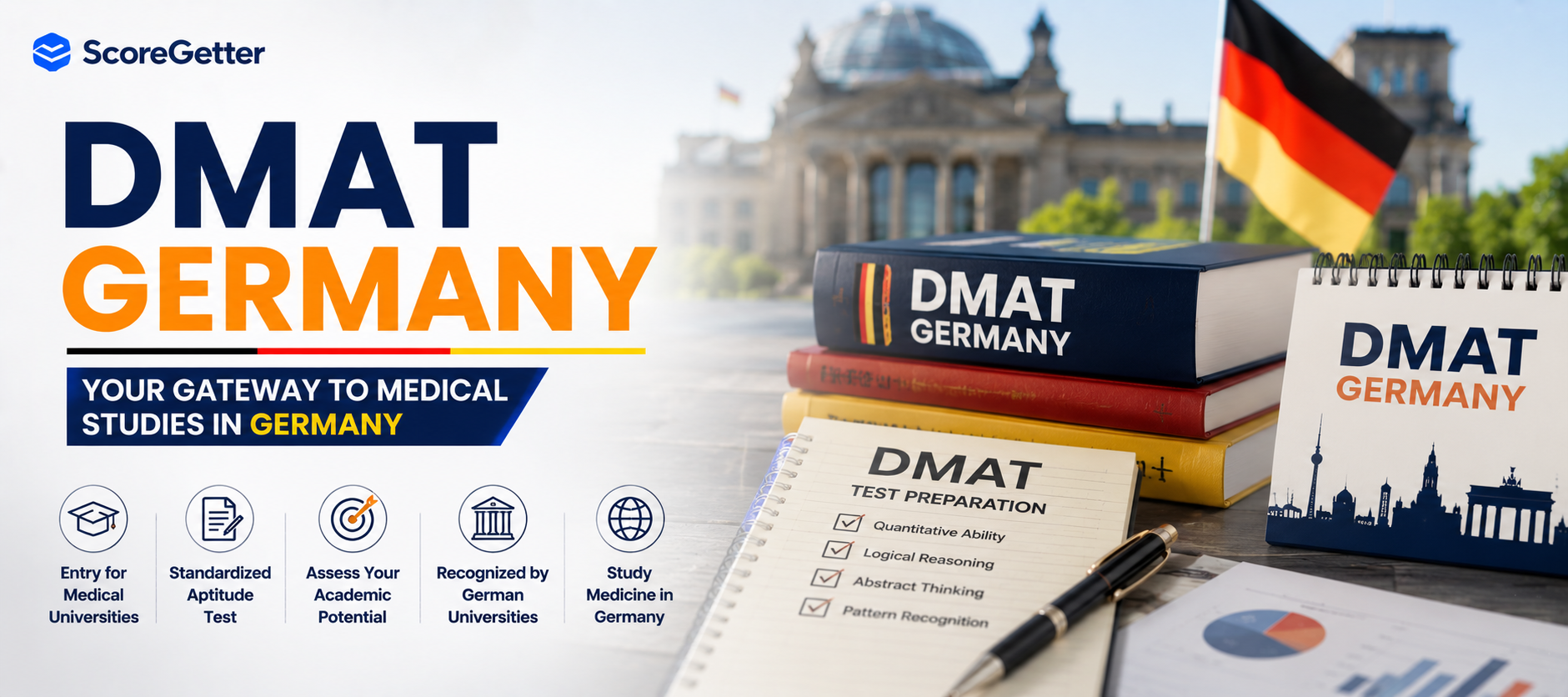
dMAT for Germany: What Is It, Who Needs It and How Does It Work?
After completing your Bachelor's degree in India, if you are thinking of doing a Masters degree in Germany, there is a new requirement that you should be aware of – the Digital Master Test (dMAT).
The dMAT is being launched in 2026 as an extra component of the APS documentation procedure for the selected Indian Master's applicants. It is not a replacement for APS, university admission requirements, your academic transcripts or language tests.
It is important to note that not all students who study in Germany for higher education have to sit the dMAT. The requirement is currently in place for certain classes of Master's applicants, primarily depending on their previous major.
What is the dMAT?
The dMAT (Digital Master Test) is a standardized academic aptitude test for admission to Master's programs in Germany.
It has been created by German universities in collaboration with g.a.s.t. (Gesellschaft für Akademische Studienvorbereitung und Testentwicklung).
The test aims to evaluate the general academic skills and, if relevant, subject knowledge of an applicant for admission to a Master's programme.
The dMAT is being launched as a new component of the APS verification process for Indian applicants.
It is important to know what the dMAT does not do:
- It is not a substitute for the APS certificate.
- It is not a substitute for your Bachelor's degree or university transcripts.
- It is not a substitute for an English or German language test.
- It is not a substitute for the university's admission process.
- It will not affect your degree or university's recognition status.
- Having a good dMAT score does not guarantee admission to a German university.
Who needs to take the dMAT for Germany?
This is the section that students must pay the most attention to.
As per the latest APS India rules, the dMAT is applicable to the selected candidates of Master's course from India whose previous degree is from these streams:
- Engineering
- Commerce / Accounting / Finance / Economics
- Business / Management
The dMAT is mandatory for applicants in these fields for Master's applications for the Summer Semester 2027 intake and subsequent intakes, unless a transitional exemption is applicable.
For instance, if an Indian student has a B.E. or B.Students with a degree in Engineering who are planning to pursue a Master's in Germany might be subject to the dMAT requirement if their undergraduate degree is in one of the impacted Engineering fields.
Similarly, graduates with degrees in areas such as Commerce, Finance, Accounting, Economics, Business or Management may also be required to take the test.
But the exact classification may be important for interdisciplinary degrees. APS India recommends students to refer to the official list of affected fields and not just the name of the Master's course they wish to pursue.
Who does NOT currently need the dMAT?
Under the current APS India rules, the dMAT requirement does not apply to several groups, including:
- Students who apply for a Bachelor's programme in Germany
- PhD applicants
- Candidates who have not studied in the above mentioned fields in their previous degree.
- Some students involved in officially recognised exchange, double-degree or university partnership programmes
- Bachelor's students who have not completed the minimum number of semesters as per the programme structure as prescribed by APS India for the relevant programme.
The rules may change, therefore it is advisable for students to refer to the latest APS India information before they start their application.
When does the dMAT requirement start?
The first dMAT test in India will be conducted on 26 September 2026.
The dMAT requirement is being implemented for the Summer Semester 2027 intake of the Master's course and future intakes.
The current first test schedule published by APS India is:
The test is being conducted in select centres in India, such as Chennai, Bengaluru, Mumbai, New Delhi, Pune, Ahmedabad, Kolkata, Bhopal, Chandigarh and Mananthavady, depending on availability.
Who is exempt under the transitional rules?
Some important transitional exemptions.
If you do not need to take the dMAT for that APS procedure, then:
- You registered for APS online prior to 29 June 2026,
- You shipped your complete APS application documents before 29 June 2026, or
- You have already gone through the APS process and have an APS certificate.
These exemptions relate to the particular APS procedure. If you make a new APS application later, the rules applicable at that time will apply.
How does the dMAT work?
The dMAT has two main components:
1. Core Module
The Core Module is a measure of general academic aptitude at Master's level.
It consists of three subtests that assess general cognitive skills that are important for university learning.
The aim is to evaluate skills like reasoning and problem solving, not just to see how much information a student can regurgitate.
2. Subject Module
The Subject Module evaluates subject knowledge and the application of this knowledge.
The specific subject module will vary depending on the subject area of the Masters and the use of the dMAT.
Currently, the dMAT website has subject modules for specific university programmes such as Chemistry, Physics, Computer Science, Electrical Engineering, Mechanical Engineering and Data Science.
The General Academic Module is the current requirement being introduced for the affected groups for Indian applicants who are going through the APS process.
The test is taken online at specific test centres.
How long is the dMAT?
The dMAT lasts about 3.5 hours, with a break between the modules.
The actual test experience, instructions and preparation material should be checked prior to the test as the test is digital and has specific rules.
What kind of questions are asked?
The Core Module is designed to assess general cognitive and academic skills.
The Subject Module (if applicable) assesses knowledge gained in the student's previous field and the ability to apply that knowledge to problems.
The dMAT is not intended to be a test of rote-learned information. According to the official dMAT information, subject modules consist of a typical problem in the subject area and questions that are related to the subject, which involve both subject knowledge and application skills.
This does not imply that students should prepare in the same way as they would for a regular university exam.
What language is the dMAT conducted in?
The existing dMAT test modules are administered in English.
This is especially important for Indian students as the test is not part of the English language requirement of the German university.
If your Master's programme has an IELTS, TOEFL or other accepted language requirement, you will still have to satisfy that requirement separately.
What is the dMAT score?
The dMAT certificate provides results on two measures:
- dMAT score
- Percentile rank
The dMAT score ranges from 0 to 200, and the percentile shows how the candidate scored in relation to other test takers.
The certificate also includes the results of the relevant modules.
A percentile is especially helpful to understand how you compare. For instance, a percentile of 70 indicates that your performance was at or above the level of 70% of the people in the comparison group.
Will a low dMAT score mean I will fail APS?
No.
The dMAT is a supplementary academic achievement outcome in the APS process. APS India is still verifying academic documents for authenticity and formal plausibility.
APS India explicitly mentions that a low dMAT score does not automatically lead to the rejection of APS certificate.
If you are in a group where the dMAT is required, however, you must still provide the dMAT certificate before APS can finish the process.
Can I apply for APS before receiving my dMAT result?
Yes.
In case the applicant is asked to appear for the dMAT, APS India allows the entire APS application documents to be submitted prior to the dMAT certificate.
APS can start the document verification process, but the APS certificate can only be issued once the required dMAT certificate has been submitted and the result has been verified.
This is helpful for students who are dealing with University Application deadlines.
Does dMAT guarantee admission to a German university?
No.
The dMAT is just one component of the entire process.
Admission decisions are still made by German universities. The Bachelor's degree, academic achievement, prerequisites for the subjects, language qualification, application documents and other programme-specific requirements may also be the basis of your application.
A dMAT certificate is not an admission guarantee.
What should Indian students do now?
Don't wait until the university application deadline to find out if the dMAT applies to you if you are planning a Master's in Germany.
Start by checking:
- Your specific Bachelor's degree major
- Your branch, major or specialisation
- If you have a previous degree in one of the impacted dMAT fields
- The status of your university.
- The APS requirements that apply to your case
- The admission criteria of the German universities you are applying to
- Your language-test requirements
- The current dMAT registration dates and test-centre availability
APS India has issued an official list of affected fields, but it also states that the list is advisory and the classification of interdisciplinary or mixed degrees may be based on the official academic documents.
Preparing for the dMAT
The first step in preparation should be to learn about the test and not just to memorise material.
Students should be familiar with:
- The Core Module question types
- Logical and analytical reasoning
- Problem-solving
- Time management
- The digital test interface
- Any relevant subject-module requirements
- Official sample questions and preparation material.
The official dMAT website offers preparation material and sample tasks for the modules available.
Final takeaway
The dMAT is an important development for Indian students who are interested in pursuing their studies at the Master's level in Germany.
However, it is not applicable to all.
Currently, the requirement is applicable to selected applicants for the Master's program from India who have completed their Bachelor's degree in Engineering, Commerce / Accounting / Finance / Economics or Business / Management, for the Summer Semester 2027 and onwards, as per the published exemptions.
Please refer the official APS India affected-fields list before registering for the test if you are not sure whether your Bachelor's degree is included in the dMAT requirement.
If you are thinking about studying in Germany in 2027 or beyond, it is advisable to clear up the dMAT, APS, university eligibility and language requirements early. These are distinct components of the application process and completion of one does not imply completion of the others.


Join the Discussion